Place-based working isn’t a new idea… perhaps it’s finally getting the recognition it deserves.
Every few months I read another report, strategy or piece of legislation that sets out an inspiring vision for communities. I always find them interesting, not because they introduce revolutionary new ideas, but because they reinforce something many community practitioners have known for years: places matter.
The principles are usually sound. Empower communities, work collaboratively, build local resilience, strengthen neighbourhoods, connect public services and support community ownership. Reading them, it’s difficult to disagree.
Communities don’t experience life in departmental silos.
People don’t wake up thinking…
“Today I’ll experience transport…”
“At 10 o’clock I’ll experience planning…”
“After lunch I’ll move into public health…”
They experience place.
Their street… Their park… Their bus… Their school… Their local shop…Their neighbours…
That’s where public policy becomes real.
Sitting in community halls and stakeholder meetings over the past few years has taught me something else. The vision is often the easy part –
The pathway is where things become complicated.
What the reports often do not fully explore is what happens when communities understand what needs to change but encounter barriers that prevent progress.
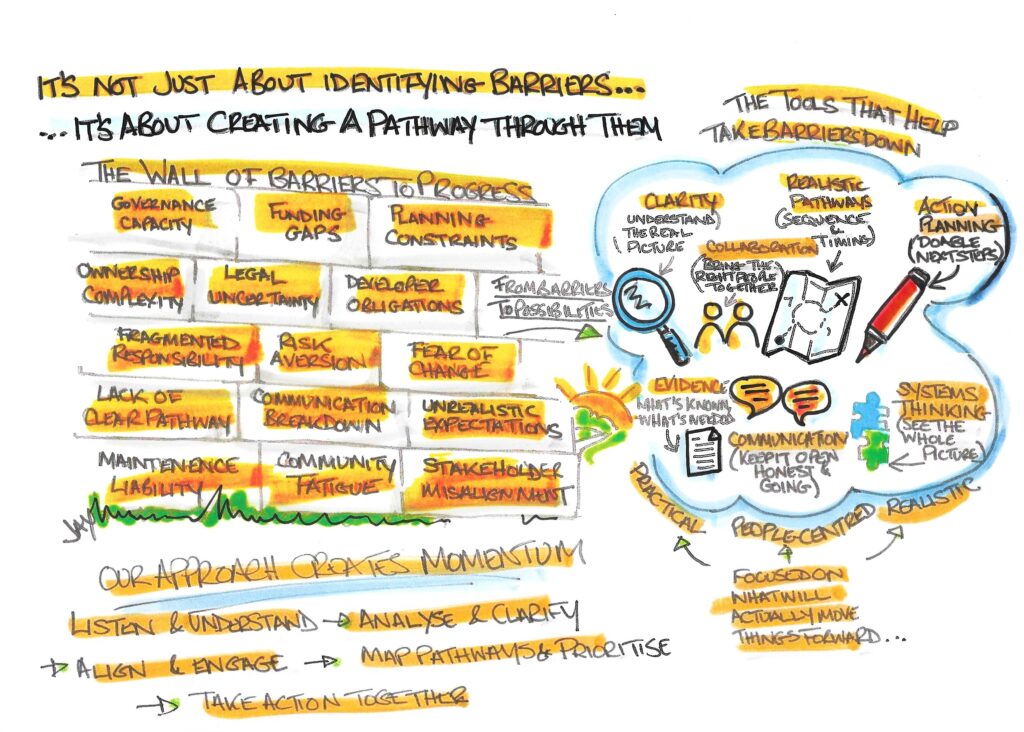
Between aspiration and delivery sits a wall, built one brick at a time. Ownership. Governance. Funding. Capacity. Planning. Legal processes. Volunteer time. Historic agreements. Organisational priorities. None of these barriers are insurmountable, but together they can feel overwhelming. It’s no surprise that communities sometimes feel stuck.
This is where I think facilitation can become much more than running a meeting.
Done well, it helps people untangle complexity before anyone starts looking for solutions. It creates shared understanding. It helps people see relationships they hadn’t noticed before and identify practical next steps they can agree on. Not because drawing pictures solves complex problems, but because making complexity visible helps people develop shared understanding.
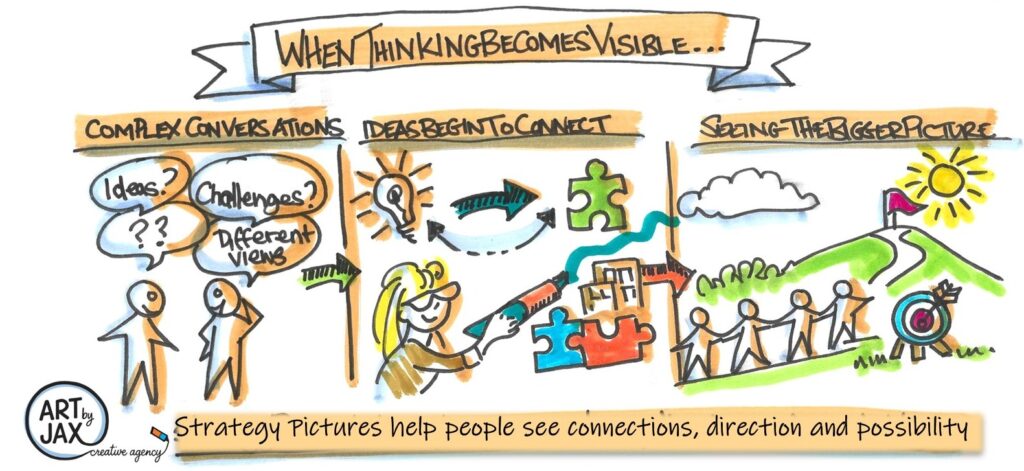
Shared understanding creates better conversations. Better conversations build stronger relationships, and stronger relationships often become the foundation for meaningful action.
Helping people understand which barriers matter, which can be influenced, who needs to be around the table, what sequence makes sense and where momentum can begin.
That’s not removing every brick. It’s finding the route through the wall.
Perhaps that’s why some projects struggle. Communities are often asked to jump from aspiration to delivery without first creating a shared understanding of the complexity sitting in between.
Community empowerment cannot simply be about creating rights.
It also needs to consider whether communities have the knowledge, the relationships, the confidence, the capacity and the support to exercise those rights.
Otherwise, empowerment risks existing more convincingly on paper than in practice.
Take the Community Empowerment Act. It created important opportunities for communities, including Community Right to Buy. But exercising those rights can involve legal advice, valuation, governance, funding, negotiation and long-term volunteer commitment. None of that means the legislation has failed. It simply reminds us that creating opportunity and navigating opportunity are two different things.
Perhaps the role of facilitation isn’t to remove every barrier.
Perhaps it’s to help people understand which barriers they can influence, who they need alongside them and where the first realistic step lies.
Because communities rarely move forward through one dramatic breakthrough.
More often, progress begins when enough people can finally see a pathway through what once looked like a wall.