There is something rather deceptive about a finished visual piece.
Once the pens are down and the colours are in place, it can look as though the whole thing was obvious from the start. The lines sit neatly on the page. The ideas appear connected. The story makes sense.
But what you do not see is everything that happened before the finished picture appeared.
The Hidden Work Before the Image
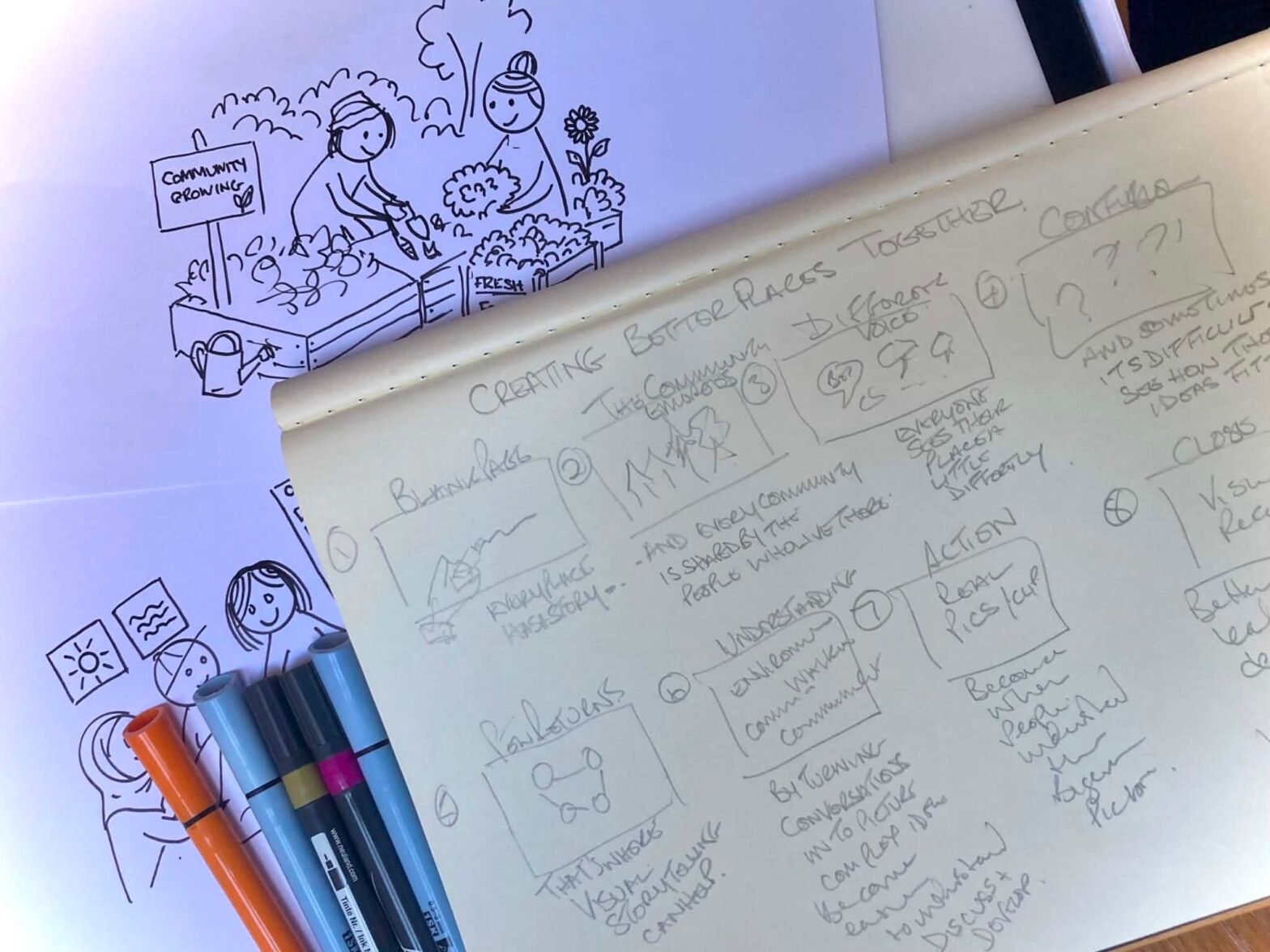
What happens before the finished picture varies enormously depending on what I’m working on, although the pattern is often much the same; what you eventually see is really only the final layer. If I’m graphic recording, there’s an enormous amount of listening and interpreting happening while the conversation is still unfolding, whereas with facilitation the thinking starts long before anyone walks into the room — who needs to be there, what we’re really trying to understand, which questions might open up the conversation and what might get in the way of people taking part.
A Community Action Plan takes that even further. By the time everything has been distilled into a set of rather neat-looking pages, there may have been surveys, conversations, scribbled notes, conflicting opinions, evidence, stakeholder discussions, false starts, unexpected successes and an awful lot of working out what actually matters.
Painting, strangely enough, isn’t so different…The finished canvas may look settled, but beneath the surface are decisions, changes of direction, covered-over marks, and layers that shaped what finally remained.
Output Is Not the Same as Process
This is not really about graphic facilitation alone. It is about a wider habit: seeing someone’s output and mistaking it for their process.
The finished cake does not show the washing-up. The finished musical performance does not show the bars played badly fifty times. The finished dressage test certainly does not show all the negotiations that preceded it. And the finished drawing does not show the thinking.
What Happens Before the Pen Moves
There is a deeper professional point here too. Visual facilitation is sometimes reduced to “someone drawing pictures while people talk.” That description misses almost all of the work.
In reality, the pen is almost the last part of the process.
Before anything reaches the page, you are already making dozens of small decisions:
- What am I hearing?
- What does this actually mean?
- Is this a standalone thought, or part of something larger?
- Have I heard this idea already, but in different language?
- Is there tension here?
- Is there a connection nobody has spotted yet?
- What deserves prominence?
- What needs to remain open?
Only then does the drawing begin.
And often, all of that thinking has happened in seconds.
By the time the ink reaches the paper, quite a lot has already happened.
I suppose I’ve always been more interested in process than polish, which may explain why I’m drawn to work where nobody quite knows what the finished picture will look like at the beginning. Give me a blank wall, a complicated conversation and a room full of different perspectives and I’m quite happy to see where we end up.
Perhaps that’s the curious thing about a finished picture. When the work has gone well, much of what created it quietly disappears; the listening, questioning, uncertainty, false starts and hundreds of tiny decisions become almost invisible, leaving behind the lines, the colour and the connections.
You don’t need to see all of that to understand the finished picture.
But it’s there…
Just behind the pens...